Every second counts when a fire breaks out. Your FM200 system discharges. The agent floods the room. And then, it leaks out through an unsealed cable entry before the fire is extinguished.
No alarm. No warning. Just a suppression system that failed when it mattered most. That is exactly what a room integrity test Qatar is designed to prevent.
Introduction to Room Integrity Test in Qatar
If your facility runs a gaseous fire suppression system, FM200, Novec 1230, CO2, or any inert gas system, a room integrity test Qatar is not optional. It is the only way to confirm your suppression agent will stay in the room long enough to extinguish a fire.
Qatar’s rapid infrastructure growth, strict Qatar Civil Defence Directorate (QCDD) enforcement, and expanding data center and petrochemical sectors have made room integrity testing a regulatory baseline, not a best practice.
Yet many facility managers still treat it as a one-time commissioning checkbox. Rooms change. New cable runs get added. Walls get penetrated. Each new opening is a leak path that silently undermines the suppression system you paid to install.
How Room Integrity Test Works in Qatar
A room integrity test, also called a Door Fan Test or Enclosure Integrity Test, measures how airtight a protected enclosure is and predicts how long the suppression agent will hold its required concentration.
The test runs in two phases:
Phase 1, Door Fan Test A calibrated variable-speed fan (Retrotec 6000 series) is mounted into an expandable panel fitted in the doorway. It first pressurizes the room, simulating the pressure of a suppression discharge, then reverses to depressurize it. Airflow and pressure readings are captured via a DM32X digital manometer throughout both directions.
Phase 2, Computer Calculation The readings are fed into specialized software alongside room volume, suppression agent type, and the height of the highest combustibles. The software outputs two numbers:
- Equivalent Leakage Area (ELA): total aggregate area of all cracks and penetrations
- Predicted Retention Time: how long the agent holds at minimum concentration
Per NFPA 2001 and ISO 14520, the system must retain at least 85% of the adjusted minimum design concentration at the top of the combustibles for a minimum of 10 minutes. Below that threshold, the room fails, leaks must be permanently sealed, and the test repeats.
A standard server room or comms room takes 1.5–2 hours to complete.
Why Room Integrity Test is Important in Qatar
Most gaseous agents, FM200, Novec 1230, CO2, are heavier than air. They sink and escape through lower-level penetrations first. A room with even moderate unsealed leakage loses agent concentration long before a deep-seated fire is extinguished, creating direct re-ignition risk.
What’s at stake without a valid room integrity test:
- Suppression agent escapes before fire is extinguished → re-ignition
- Equipment and data loss in server rooms and control rooms
- Regulatory non-compliance and failed QCDD inspection
- Insurance claims invalidated after a fire incident
- Costly emergency remediation instead of planned maintenance
Compliance Requirements for Room Integrity Test in Qatar
Room integrity testing sits at the intersection of international standards and local QCDD regulation.
| Standard | Scope |
| NFPA 2001 | Sets the 85%/10-minute agent retention rule |
| ISO 14520 | International gaseous suppression performance framework |
| ISO 14644 | Cleanroom standards for pharmaceutical and semiconductor facilities |
| QCDD Regulations | Local authority approval and civil clearance requirements |
QCDD requires a successful room integrity test report as part of civil clearance for any gaseous suppression installation. Testing is also mandatory after any structural modification, new cable entries, HVAC changes, or renovation works, to the protected enclosure.
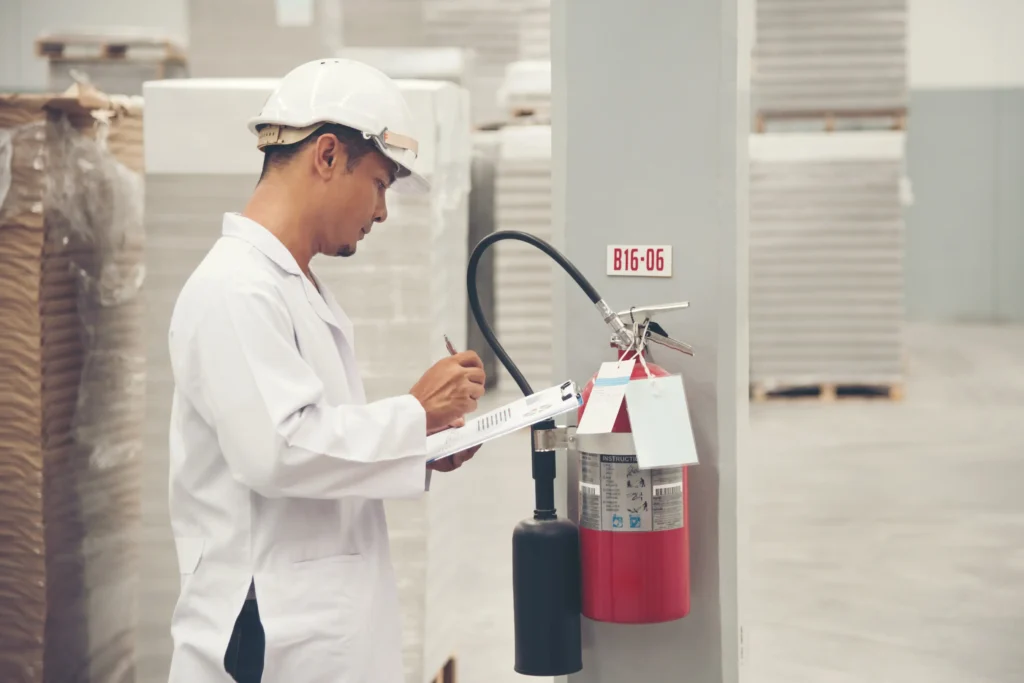
Why Choose Fire pro Best Integrity Test company in Qatar
Not every provider among the fire fighting companies in Qatar has the equipment, certification, or methodology to produce a technically defensible room integrity test report. Here’s what sets Fire Professionals apart:
- Retrotec-Certified Equipment, Retrotec 6000 Series fan systems paired with the DM32X digital manometer. Results are traceable, reproducible, and accepted by QCDD inspectors. Rooms up to 1,500 m³ tested in a single engagement.
- QCDD-Approved & Triple ISO Certified, ISO 9001, 14001, and 45001 certified. Documentation is built to pass civil clearance, not just generate a report.
- Test, Identify, Seal, Retest, Digital pressure analysis pinpoints exact leak locations. Full QCDD submission documentation and pre/post-discharge testing included, not a pass/fail report.
- 24/7 Coverage: Spans hospitality, banking, commercial, and industrial sectors. AMCs include integrity testing as a scheduled service at lower per-visit rates than standalone bookings.
They also offer foam conductivity test Qatar, air tightness testing, fire alarm maintenance, and full suppression system installation, one partner, all fire safety obligations.
Importance of Room Integrity Test in Qatar
Every sector running gaseous suppression in Qatar has specific exposure:
- Data Centers & Server Rooms: FM200 and Novec 1230 protect hardware and data. A failed integrity test means agent loss before suppression is complete.
- Oil & Gas Control Rooms: Qatar’s LNG sector demands strict fire protection in switchgear and control environments. QCDD enforcement here is rigorous.
- Telecom Exchanges: Clean agents avoid both fire damage and water damage to sensitive transmission equipment.
- Pharmaceutical & Cleanroom Facilities: ISO 14644 compliance requires dual validation of suppression retention and contamination control.
- Museums & Cultural Institutions: Qatar’s cultural infrastructure uses clean agents to protect irreplaceable collections without collateral water damage.
In every case, the cost of a failed integrity test and corrective resealing is a fraction of the cost of a suppression failure during an actual fire.
Final Thoughts
A room integrity test Qatar is a 1.5–2 hour procedure that validates years of investment in fire suppression infrastructure. In Qatar’s regulatory environment, it is also the documented proof that your FM200 or clean agent system will perform when it needs to.
If your facility has a gaseous suppression system and has not been tested in the last 12 months, or has undergone any structural, MEP, or HVAC modifications, you are operating with unvalidated fire protection.
Get in touch with us to schedule a certified room integrity test in Qatar.
FAQ
It confirms your gaseous suppression agent stays at fire-extinguishing concentration for the required 10 minutes.
Yes. QCDD requires a passed room integrity test report before granting civil clearance for any gaseous suppression system.
Data centers, oil and gas, telecom exchanges, hospitals, pharmaceutical cleanrooms, banks, museums, and government facilities.
Cost varies by room volume, number of enclosures, and site access. Contact Fire Professionals for a quote.
Seal all penetrations, shut down HVAC, close dampers, isolate the FM200 system, and provide 15-amp power supply.
Room volume, number of enclosures, site access conditions, remediation scope, and whether testing is AMC-included or standalone.